Matthew 5:1 And seeing the multitudes, he went up into a mountain: and when he was set, his disciples came unto him:

The traditional site of the Mt of the Beatitudes is the tree covered hill on the north end of the Sea of Galilee. Like Bear Lake (in both shape and size) that straddles the Utah Idaho border, the Sea of Galilee is surrounded by mountains and hills. There is a natural amphitheater on the left/west side of the Church-topped hill
 Church of the Beatitudes (center of photo)
 It is easy to image how disciples could have spread themselves along the hill side with Jesus teaching from down blow near the banana plants

On my first visit to the mount in 1979, two friends and I sat on large rocks under the Eucalyptus tree to the right of the church and read the Sermon on the Mount. There are plenty of big rocks for sitting. We then walked down to the shore of the sea while singing the lovely hymn Each Cooing Dove (in the old LDS hymn book). I introduced that long forgotten song to all three semesters of Jerusalem Center Students. Some, like me on my first trip to Israel, connected with the hymn while walking whee Jesus walked in the Galilee. Watch some of the summer BYU Jerusalem Center students sing the hymn at the German Templar Cemetery in Haifa. https://www.youtube.com/watch?v=PsHWFwZkPJ4
 Most enjoyable with the altos, tenors and basses echoing each phrase sung by the sopranos.


The Church of the Beatitudes was built in 1938 with the support of fascist dictator Benito Mussolini of Italy. Ruins of a 4th century Byzantine Church are on the property which adds some possible authenticity to the location.
 Glass widows inside the dome state the 9 beatitudes in Latin.

 The hill (center) is within easy walking distance of Capernaum (right on the shore), the center of Jesus' Galilean ministry.
14 Ye are the light of the world.
 Roman era lamp. Fueled by olive oil.
14. A city that is set on an hill cannot be hid.
 source: https://www.ccel.org/bible/phillips/CP051GOSPELMAPS.htm
There were many more cities/villages surrounding the Sea of Galilee at the time of Christ than today. Hippos, one of the cities of the Decapolis which sits atop the eastern hills, would have been easily visible. So too would have been Chorazin north f the sea.
 Ruins of Hippos
 View westward from Hippos on the Hill.
 Modern day city of Tiberius on the western hills.

Tiberius was mainly just along the shore at the time of Jesus, but today it has grown up the hills. It cannot be hid.
 The northern mid hill extension to the north/right is where the Galilee Branch of The Church of Jesus Christ of Latter-day Saints was housed from 2007-2017.

This villa was purchased and renovated by the Church with the specific purpose of it being a place of worship on the hills of Tiberius.

In 2017 the branch house was shuttered (with no explanation to local members) and meetings were shifted to first a hotel and then a member's house in Haifa.
 The balcony of the Church offered commanding views down to the Sea of Galilee. View to the north.
 View to the northeast.
 The City of Maghar on a hill to the northwest of the sea.

A village in the West Bank (somewhere between Ramallah and Nablus) that to me is a classic city on a hill that cannot be hid.
41 And whosoever shall compel thee to go a mile, go with him twain.
 Roman milestones placed together in the hills of the Shephela
 Ghaleb, Yasmin and Chad
The BYU Jerusalem Center is also a great example of peacemakers and loving enemies. The staff at the center is purposely comprised of a nice mix of Israeli Jews, Palestinian Arab Muslims and Palestinian Arab Christians. They all get along and are friends. In each of these photos of local administrators and staff at the center (and a few Emmetts too) there is no repeat of religion--above photo is Palestinian Muslim, Israeli Jew and American Mormon and below it is Palestinian Christian and Israeli Jew.
 Tarek and Eran

 Hassan and Tawfiq
 Malak and Marie

The traditional site of the Mt of the Beatitudes is the tree covered hill on the north end of the Sea of Galilee. Like Bear Lake (in both shape and size) that straddles the Utah Idaho border, the Sea of Galilee is surrounded by mountains and hills. There is a natural amphitheater on the left/west side of the Church-topped hill


On my first visit to the mount in 1979, two friends and I sat on large rocks under the Eucalyptus tree to the right of the church and read the Sermon on the Mount. There are plenty of big rocks for sitting. We then walked down to the shore of the sea while singing the lovely hymn Each Cooing Dove (in the old LDS hymn book). I introduced that long forgotten song to all three semesters of Jerusalem Center Students. Some, like me on my first trip to Israel, connected with the hymn while walking whee Jesus walked in the Galilee. Watch some of the summer BYU Jerusalem Center students sing the hymn at the German Templar Cemetery in Haifa. https://www.youtube.com/watch?v=PsHWFwZkPJ4


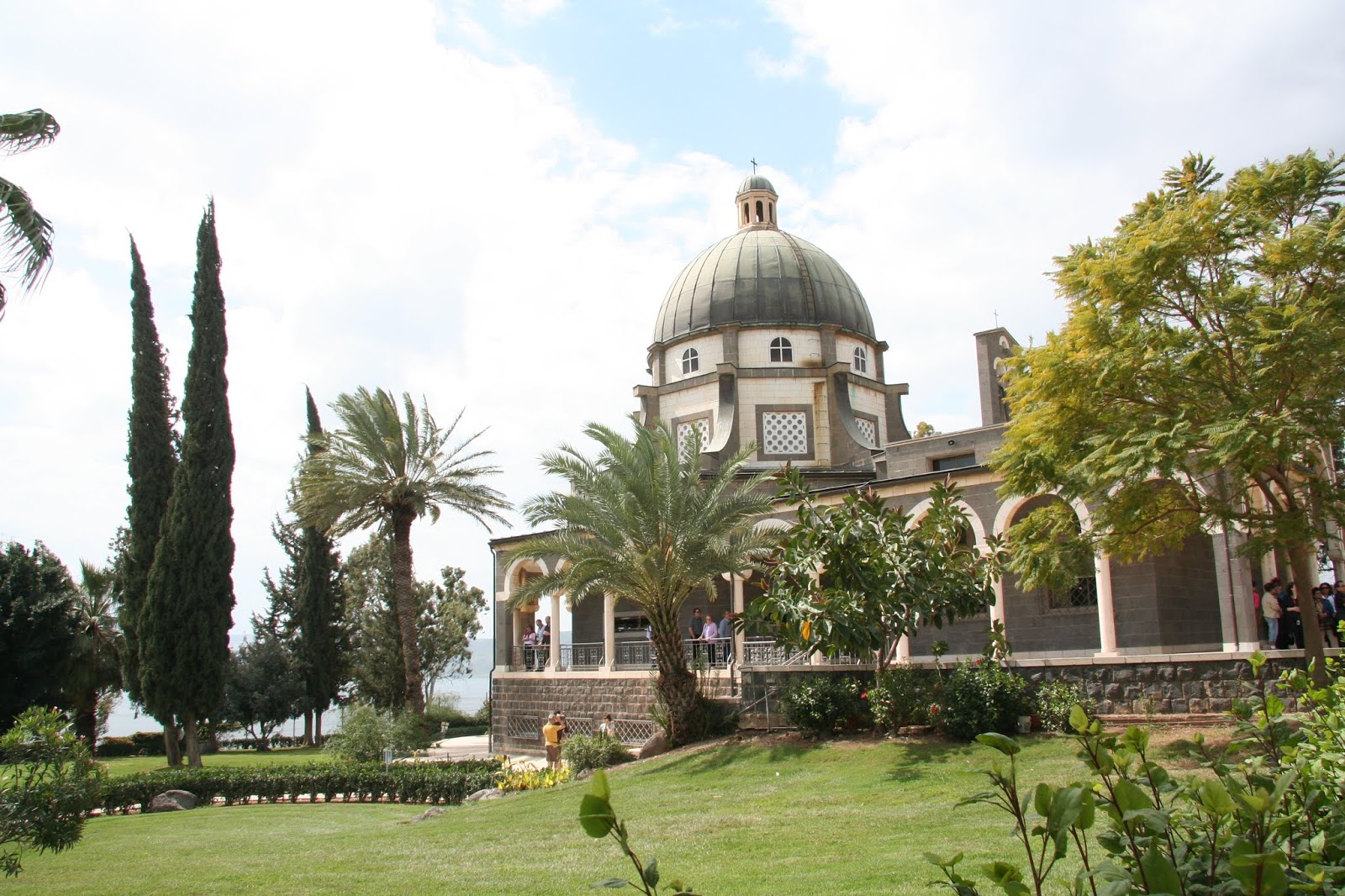
The Church of the Beatitudes was built in 1938 with the support of fascist dictator Benito Mussolini of Italy. Ruins of a 4th century Byzantine Church are on the property which adds some possible authenticity to the location.


14 Ye are the light of the world.

14. A city that is set on an hill cannot be hid.

There were many more cities/villages surrounding the Sea of Galilee at the time of Christ than today. Hippos, one of the cities of the Decapolis which sits atop the eastern hills, would have been easily visible. So too would have been Chorazin north f the sea.


Tiberius was mainly just along the shore at the time of Jesus, but today it has grown up the hills. It cannot be hid.


This villa was purchased and renovated by the Church with the specific purpose of it being a place of worship on the hills of Tiberius.

In 2017 the branch house was shuttered (with no explanation to local members) and meetings were shifted to first a hotel and then a member's house in Haifa.


A village in the West Bank (somewhere between Ramallah and Nablus) that to me is a classic city on a hill that cannot be hid.
41 And whosoever shall compel thee to go a mile, go with him twain.
43 ¶ Ye have heard that it hath been said, Thou shalt love thy neighbour, and hate thine enemy.
44 But I say unto you, Love your enemies, bless them that curse you, do good to them that hate you, and pray for them which despitefully use you, and persecute you;

The Holy Land at the time of Christ and today was and is a land of conflict and a land of enemies. I took this photo in the Old City of Jerusalem in 1989 during the first Intifada (uprising). I don't know what had happened, but when I walked by the Israeli solider had all of the Palestinian youth lined up and being lectured to.

My experience over the years has been that there are many good people in the land, many peacemakers and many who love, like, or (better than nothing) tolerate their neighbors. Here I am in 1979 with three Israeli residents of Kibbutz Degania--the first kibbutz (agricultural communal settlement) to be established. We were volunteer workers at the kibbutz for two weeks and our task on this day was to shovel out chicken manure from the large chicken shed in the rear. Interacting this closely with Israeli kibbutzniks was a good experience for the Fall Semester 1982 BYU students. We were warmly welcomed into their midst and were treated with kindness and friendship.

In 1989 I traveled to Hebron (in the southern West Bank) with a friend to see the Tomb of the Patriarchs. An Israeli solider on patrol thought it was crazy for us two foreigners to be walking through the Arab market. I wasn't worried. It was a dangerous place for Israelis, but we both had cameras and back packs and certainly looked like tourists--who were never targeted. I was also wearing a shirt with University of Chicago written in Arabic on the front. The shirt alone was a walking invitation for Arab hospitality. We struck up a friendship with these three Arab men who then invited us to their home for lunch.

One of the best examples of loving your neighbor and being peacemakers was exhibited by the members of the Galilee Branch during my 1988-89 membership in that branch. Branch President Michael Hansen's (standing behind his wife Ann on the far right) parents (his mom is in the rear holding a granddaughter) were American Jews who converted to Mormonism and then emigrated to Israel when Michael was a teen. Michael served in the Israeli military before serving his mission. The first counselor in the branch was Ehab Abunuwara (left side second from top) from Nazareth who I refer to as my Israeli/Palestinian/Arab/Greek Orthodox/Mormon roommate. He was first introduced to the Church by responding to an add in the Reader's Digest that offered a free Copy of the Book of Mormon. Other branch members included a mixed Jewish/Mormon family from Argentina (left and back right), a UN solider from Austria (back center), and a physical therapist (center) from Alberta. More recent members in the branch have included immigrants from Russia and Armenia, workers from the Philippines, another Arab family from Nazareth and others. What is impressive about this branch of mixed nationalities and mixed religious heritages is that they all get along. The most impressive example of this is how the branch presidency of Michael and Ehab chose to interact. They both told me on different occasions that since they viewed the Palestinian/Israeli conflict from very different perspectives they had each decided that they would not talk politics at church. They liked each other and were good friends, but they knew if they ever started to talk about the conflict it could be very divisive. These two men had many good reasons to consider the other the enemy, but they chose to act and view the other as a friend.

The BYU Jerusalem Center is also a great example of peacemakers and loving enemies. The staff at the center is purposely comprised of a nice mix of Israeli Jews, Palestinian Arab Muslims and Palestinian Arab Christians. They all get along and are friends. In each of these photos of local administrators and staff at the center (and a few Emmetts too) there is no repeat of religion--above photo is Palestinian Muslim, Israeli Jew and American Mormon and below it is Palestinian Christian and Israeli Jew.


Mahmoud and his buddy Will


Luke 6: 48 He is like a man which built
an house, and digged deep, and laid the foundation on a rock: and when
the flood arose, the stream beat vehemently upon that house, and could
not shake it: for it was founded upon a rock.
 House built on a rock. Southwest of Bethlehem.


