What a great week. The kids were out of school for the week for Easter/Passover/spring break. On Monday they tagged along on the Christian Quarter field trip. It started at New Gate.
 Just inside New Gate is Terra Sancta--the Franciscan headquarters. It is now a monastery but in the 1800s the Franciscans had a pilgrim hospice here. One of only two (I think) in the city at that time. Elder Orson Hyde wrote of staying in a hospice near the new gate when he came to dedicate the Holy Land.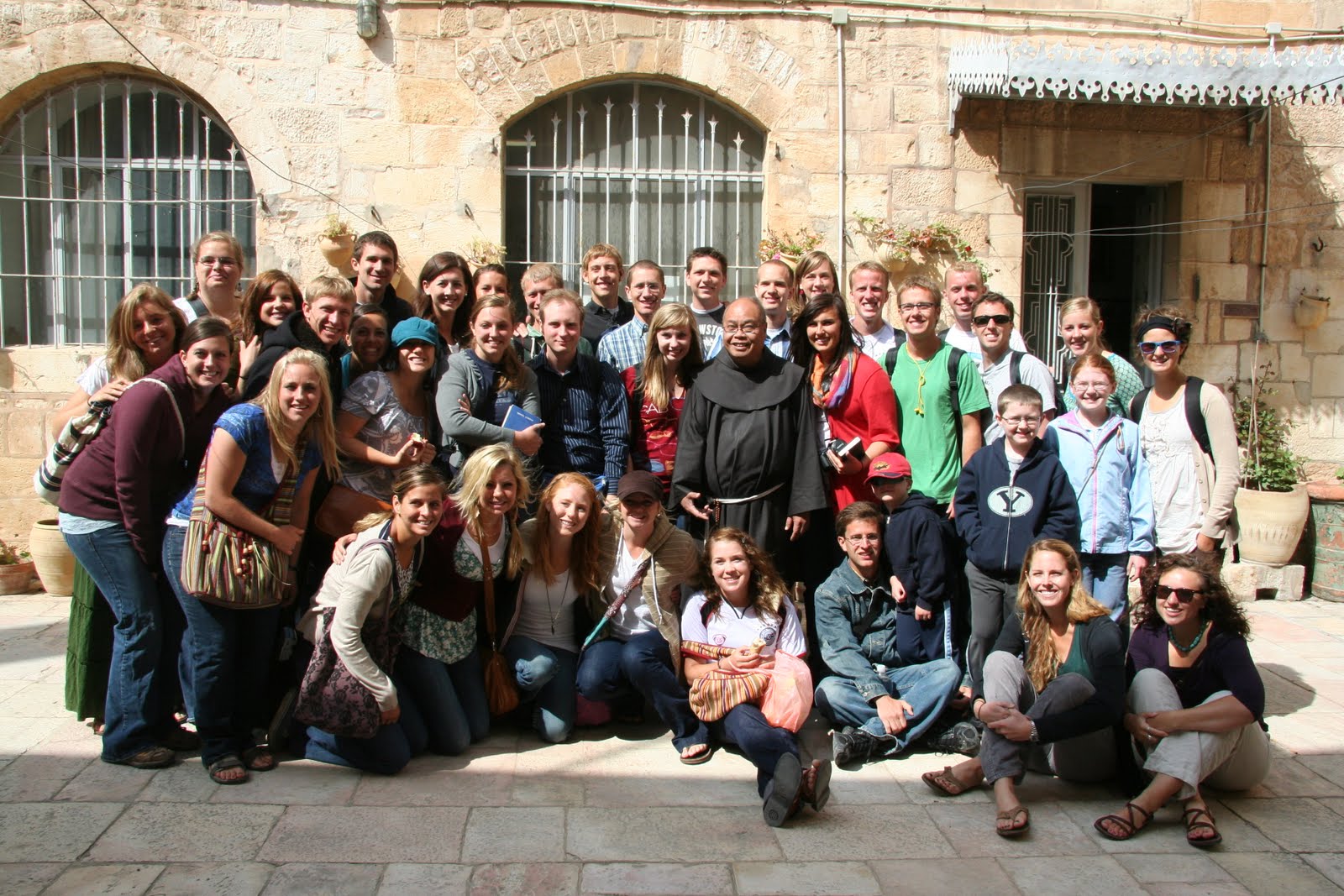
Father Angelo (Filipino from Hawaii and elsewhere) has graciously been showing BYU students a possible Hyde siting. Here we are in the courtyard outside the tailor shop--where the brown robes are made.
 In the current laundry/tailor shop there is a wooden door from the hospice days.
If you look close you can see HYDE carved in the door. There is no other evidence to substantiate that this is Elder Hyde's doing, but it very likely could be.
 As part of the field trip we also visited the Syrian Orthodox Church of St. Mark in the Armenian quarter. This old church claims to be located on the site of the home of Mark's mother and the site of the upper room of the last supper and the gathering at the day of Pentecost. This painting in the church depicts Christ washing the feet of the apostles on the last supper night.
 Another interesting stop is the Russian Orthodox Church of Alexander Nevsky. It sits on the eastern end of where the large Byzantine Basilica of the Holy Sepulcher once stood. Ruins within the church include the location of the possible gate that led from the city out to Golgatha.
 The Church has lovely paintings of events associated with the Passion of Christ.

 We also visited the Church of the Holy Sepulcher. After the morning field trip, we stayed in the Old City for a felafel lunch and then we climbed the square tower of the Lutheran Church of the Redemer for its great view down on the Holy Sepulcher.
 Looking south from the tower we could see the new Hurva Synagogue in the Jewish Quarter that was recently dedicated. The original synagogue was blown up in the 1948 war.
 Walking back to the center, I stopped to take some fig photos. On his journey into Jerusalem the Monday of the holy week Jesus cursed a fig tree for not having any fruit. By the last week of March you can already see fruit on the tree. Fruit sprouts the same time as the leaves. Jesus cursed the tree because it had leaves and should have thus had fruit.
 The cursing of the fig tree becomes symbolic of the fruitless Pharisees who outwardly look like they should have fruit--because of all of the leaves, but they are fruitless.
 On Wednesday we went on a field trip with Israeli attorney Danny Seidemann to learn about Jewish Settlements in East Jerusalem and the Wall. This view from the Mt of Olives reminded me of two events of the last week: Jesus likening the scribes and Pharisees to whitened sepulchers and his lament over Jerusalem (Oh Jerusalem, how oft would I have gathered you....)
 The view from the Mt. of Olives eastward. This was one of the clearest days ever so it was easy to see the Dead Sea and the hills of Jordan (Perea). The first town is Arab and the second is Israeli (Maale Adumim). Jericho is down in the valley. The Gospels record that Jesus went "up" from Jericho to fulfill his mission.
 On Thursday our afternoon field trip took us into the West Bank to the Herodian--the hill top fortress with palace below of Herod the Great. (this is a December 2009 photo--the hill is much greener this time of year)
 The view from atop the Herodian toward the Dead Sea and Jordan (the area of Biblical Moab) beyond.
 Looking south toward Tekoa--the home town of the prophet Amos. This is a good example of the intertwining of Arab and Jewish settlements in the West Bank. The farthest village is Arab Tequ'a (the Arab name preserved the Biblical name). The orange tiled houses are part of Jewish Tekoa. Then up close is another Arab village.
 The view from the Herodian westward toward Bethlehem. It is interesting to think that Herod may have been staying here when the angels came to visit the shepherds in nearby fields and that the wise men may have come to visit Herod in his Herodian palace rather than his Jerusalem palace.
 Inside the hill top--once a fortress for Herod's soldiers, then a hold out for Jewish rebels.
 By the pillar of a post Herodian synagogue.
 After the Herodian we had a Shepherd's field experience. We were located on a hill just south of the southernmost Jerusalem neighborhood of Har Homa where we looked south across a valley to Bethlehem.
 Down in the valley were four watchtowers. The Emmett children and some of the students were the first to find them as they went exploring. I then went to take photos. This was an exciting find for me.
 Notice the tower in upper right corner.
 This was my favorite.
 Watchmen would stay inside the towers at night. They could stand on top to watch for intruders to their farm land. Ezekiel 3 talks about the importance of watchmen on towers and Jesus notes that is someone is going to build a tower he counts the costs first.
 The views down the valley from the Watch tower.
 We had a delightful nativity program (just a week before April 6th)
 The view east toward Beit Sahour--the traditional site of Shepherd's Field. Notice the winding road and security fence (not a wall in rural area) separating Bethlehem from Jerusalem.
 Friday morning Marie and the kids hosted an Easter egg dying party with a family from the branch.
 After teaching my two hour new testament class. I then went down to the Via Dolorosa for the Good Friday procession. The staging point was an Arab School located where the Antonia Fortress (where Jesus was tried before Pilate) once stood.
 The south windows and openings of the school look south on to the Temple Mount/Haram al-Sharif. This is a similar view Roman soldiers would have had thus allowing them to keep and eye on what was happening on the Temple Mount.
 Rather than follow in the procession, I walked ahead to stop and take photos as everyone passed. First to come was an evangelical group with characters acting the part.
 Then some Ethiopian pilgrims--stopped here at the fourth station of the cross.
 Franciscans--who lead a procession every Friday afternoon--then came.
 This is a group of Christians from Sri Lanka
 The final and largest group were the Arab Christians--mostly Roman Catholic.
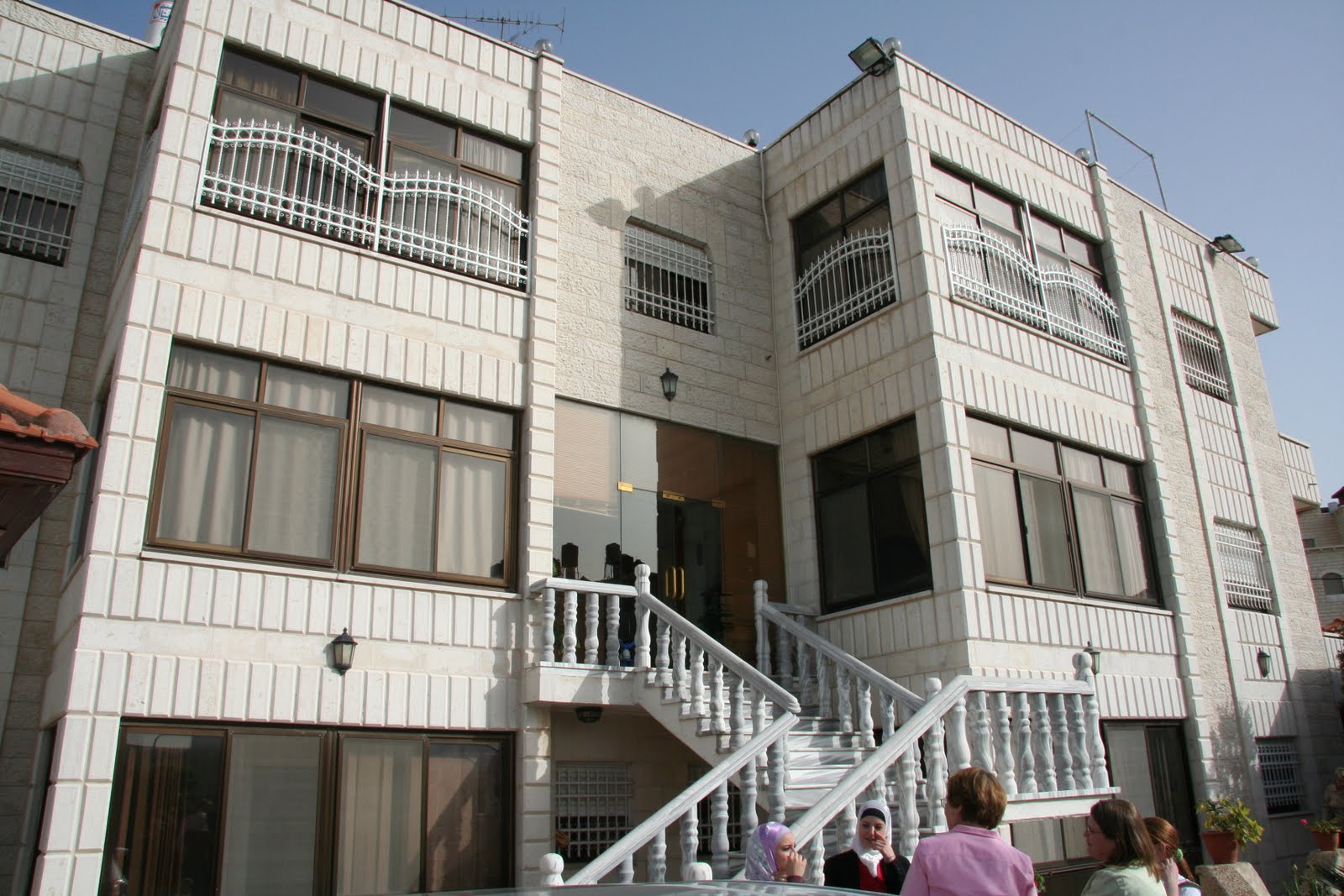 Later that day we were invited to the Qawasmi home for dinner. The father is the owner of the bus company used in transporting the BYU students. Two of his sons are BYU graduates. The parents and their teenage daughter live on second level. Two married sons live in third story apartments and a third unmarried son lives in a first floor apartment.
 The other half of the lowest level is a big room used for family gatherings and meals. It reminded me of the room added on to my parents' home so that we could all fit for holidays and Sunday meals. The meal was the best meal so far for my holy land stay: stuffed zucchini, stuffed artichoke, stuffed potatoes, stuffed grape leaves, kibbeh (bulgur coated meatballs), salad and eggplant dip, plus fresh squeezed orange juice. Fresh fruit cups for dessert. It must have taken days to prepare. So delicious.
 The Qawasmi family. They are Muslim Arab Palestinians from Jerusalem (Beit Hannina). The father runs a bus company and his three sons are all college graduates. One is a human rights attorney, another an accountant and the third works in PR. The two daughters-in-law both are trained pharmacists who studied in Jordan. A second daughter is in Scotland working on an MA degree. Shadi on the far right was a student in several of my geography classes at BYU. We had him to dinner several years ago in Springville. I wish all Americans could spend an afternoon with the Qawasmi family. By doing so many false impressions and prejudices would be dashed. They are a close-knit, loving, hospitable family.
 Saturday we attended the Jerusalem branch Fast and Testimony meeting (other meetings were canceled so we could come back and watch the first session of conference that evening. After church I took five students with me to visit a member of the branch (from the Philippines) who has been in the hospital (40 minute drive) for three months with an acute case of TB and Pneumonia. He is on the mend but it had been a long haul. I have spend many Sabbaths visiting him. Marie always sends tasty treats in an attempt to fatten him up. That evening we listened live to the first session of conference. Marie had prepared conference activity sheets for the kids. I sat by Will as he filled up his conference bingo sheet with mini-M&Ms. He did really well at hearing words and matching them to the pictures. Soon he discovered that Jesus Christ was frequently mentioned so with a smile he started to put an M&M on the Jesus box every time he heard the name. Soon he had a large pile.
This morning we attend the 9:30 worship service at the Garden Tomb. A rock band stood in front of the tomb (in the distance at center left). The music was upbeat and fun (maybe we Mormons could learn a thing or two here--or perhaps such music is only good for Primary and EFY) . The sermon was out of 1 Corinthians 15. It was nice to celebrate the resurrection of Jesus with Christians of all kinds.
 There was also a sunrise service, but we and many others chose a more reasonable time.
 We then walked to the other possible site of the resurrection--The Church of the Holy Sepulcher which is known in Arabic as the Church of the Resurrection (a better name I think). This is Catholic mass in front of the tomb. Notice the brass balcony above.
 When we went into the Greek Orthodox Katholikon I noticed people climbing up to what I discovered was this balcony. It offered a great view down on the services and tomb. Shortly after the kids and I had climbed down, a very upset Greek Priest came raging in and cleansed the balcony.
 The rotunda of the Katholikon.
We all leave for a four day field trip to Jordan at 7:00 am in the morning. The kids are excited to spend their second week of spring break exploring Petra and Jerash.